
A plot booking form records who is booking which plot, at what rate, and how much they've paid to hold it. It's the first document in a plot sale. The token receipt, the agreement to sell and the allotment all follow from it. A good form has six parts: the buyer, the plot, the price, the booking amount, the terms, and the signatures.
Format: free, in Word and PDF, English and Hindi, no sign-up
For: plotted developers, their site offices and associates
Next step: if you book many plots, real estate booking software keeps the same details for every booking in one place
What should a plot booking form include?
Every field below has a reason. Most booking disputes start with a missing one.
Buyer details: full name, father's or husband's name, address, mobile, email, and PAN and Aadhaar numbers. Add a co-applicant if the plot is booked jointly.
Plot details: scheme name, plot number, plot size (in sq yd and sq ft), facing, and corner or park-facing if it applies.
Price: rate per sq yd, basic value, PLC (preferential location charges) if any, other charges, and the total value of the plot.
Booking amount: amount in figures and words, payment mode (UPI, cheque, RTGS, DD or cash), and the reference number, cheque number or UTR.
Booked through: the associate or channel partner's name and mobile, if there is one.
Terms: what happens if the booking is cancelled, the time to sign the agreement to sell, and whether the booking amount is refundable.
Signatures: the buyer, any co-applicant, and the developer's authorised signatory, with the date and place.
For office use: booking number, received by, and "verified by accounts" with a date.
The format
[DEVELOPER NAME / LETTERHEAD]
PLOT BOOKING FORM

Booking no.: __________          Date: ___ / ___ / ______

1. APPLICANT
Name: ______________________________________________
Father's / Husband's name: _________________________
Address: ___________________________________________
Mobile: __________________   Email: _________________
PAN: _____________________   Aadhaar: _______________

Co-applicant (if any)
Name: ____________________   Relation: ______________
PAN: _____________________   Aadhaar: _______________

2. PLOT
Scheme: ____________________________________________
Plot no.: _________   Size: ______ sq yd (______ sq ft)
Facing: ___________   Corner / park-facing: Yes / No

3. PRICE
Rate: ₹ _________ per sq yd
Basic value: ₹ _____________
PLC (if any): ______ %  = ₹ _____________
Other charges: ₹ _____________
Total value: ₹ _____________
(in words: _________________________________________)

4. BOOKING AMOUNT
Amount: ₹ _____________ (in words: ___________________)
Mode: UPI / Cheque / RTGS / DD / Cash
Reference / cheque no. / UTR: ______________________
Bank: _____________________   Date: ___ / ___ / ______

5. BOOKED THROUGH (if any)
Associate / channel partner: ______________________
Mobile: __________________

6. TERMS
a) The agreement to sell will be signed within ____ days of this booking.
b) If the applicant cancels, ____________________________________
   ______________________________________________________
c) The booking is confirmed only after the payment is received
   and verified by the developer's accounts team.

7. SIGNATURES
Applicant: _______________   Co-applicant: _______________
For [Developer name], authorised signatory: _______________
Place: ____________________   Date: ___ / ___ / ______

FOR OFFICE USE
Received by: _______________   Verified by accounts: ___________
Date verified: ___ / ___ / ______
This format is a starting point, not legal advice. Rules on stamp duty, registration and RERA differ by state. Have your lawyer check it before you use it.
How do you fill it in without mistakes?
Write the plot size in both units. Buyers in many cities think in sq yd (gaj), while plans and banks often use sq ft. Writing both avoids a dispute later.
Write the booking amount in words as well as figures, and copy the UTR or cheque number exactly.
Don't confirm the booking until accounts has verified the payment. A UPI screenshot isn't a received payment.
Fill in the cancellation term before the buyer signs. A blank term is the most common cause of refund disputes.
Give the buyer a copy, together with a token money receipt.
What happens after the booking form?
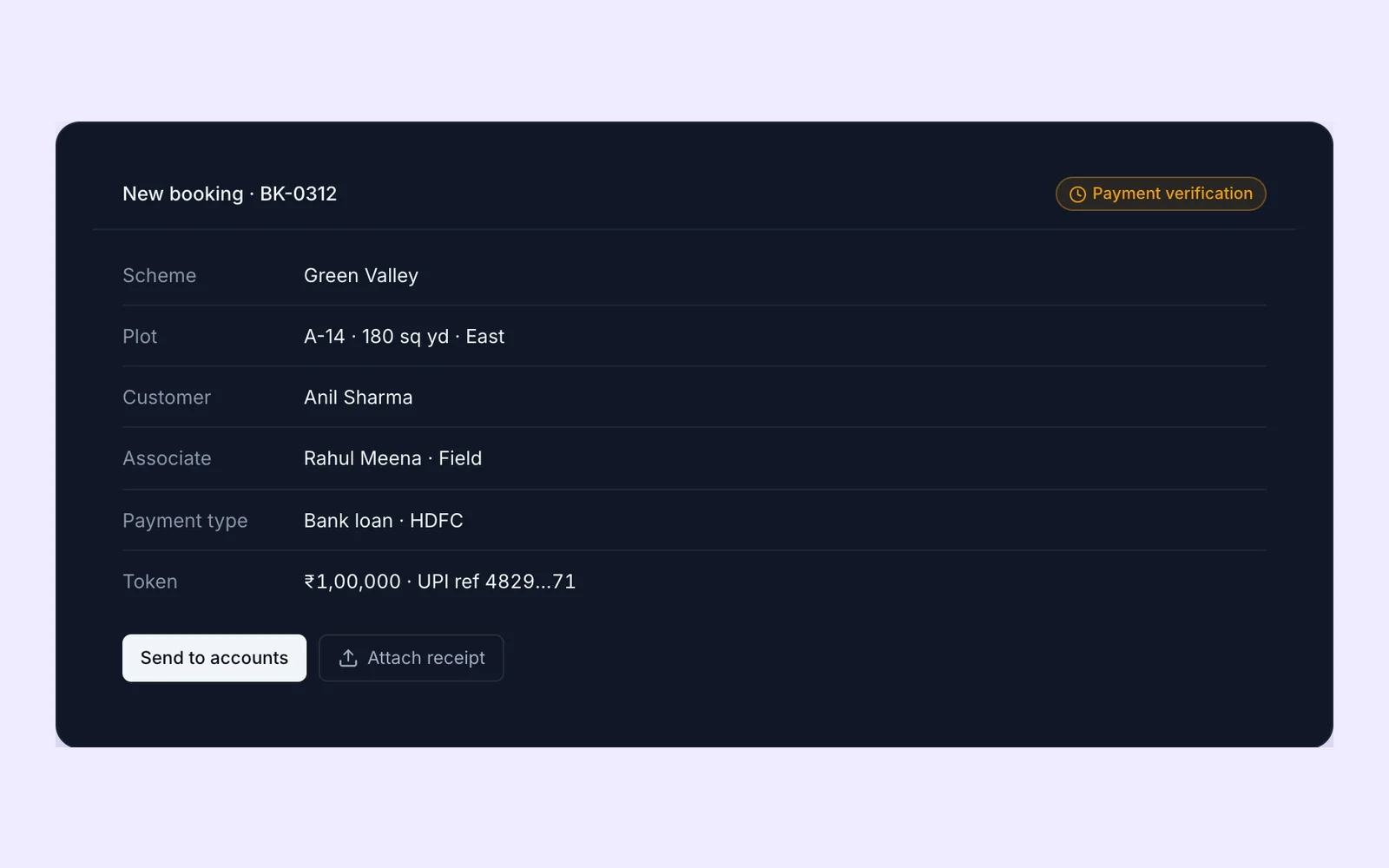
The order is usually the booking form, then the token money receipt, then an agreement to sell, then KYC, allotment, patta and closing. On paper, each step lives in a different file or register. In Estatrail, the booking is one record that moves through eight steps, from token to closing: agreement, signature, KYC, allotment approvals, patta, the bank's DD for loan sales, and closing. The booking moves through those steps in order, and a payment counts only after accounts verifies it. See how bookings move between desks. Next: the token money receipt.
Frequently asked questions
Is a plot booking form a legal agreement?
It's a record of the booking and the amount paid. The agreement to sell, signed later, sets out the full terms of the sale. Under RERA, a developer can't take more than 10% of the plot's cost as an advance before signing and registering a written agreement for sale.
Can I use this format in Word?
Yes. Download the Word file, put it on your letterhead, and fill in your own terms.
What size should the booking amount be?
That's the developer's decision. Many keep it well below 10% of the plot value, because of the RERA limit above.
Can associates book plots from their phone?
In Estatrail, yes. Bookings are entered by the scheme manager or the associate, and every booking carries the same details as this form. Ask us for a demo.
Booking many plots a month? Estatrail keeps every booking, payment and document on one record, from token to closing.
Every plan has a 14-day free trial. See pricing.
Written by Estatrail Team · Reviewed by Anwar Hussain · Updated 20 Nov 2026